Page 1 of 1

[Lore] Esikkent, Turkey

Posted: 29 Jun 2026, 11:49
by The Quill
Esikkent, Turkey
Image

Esikkent is the hidden magical city beneath Istanbul, built through cisterns, tunnels, bath chambers, and old stone passages that descend far below the streets above.

Also known as the Threshold City, Esikkent takes its name from the First Threshold Accord, the Roman-era agreement that first joined Constantinople to the White Ember Court of Heliopolis.

At the center of the city stands the Janus Gate, the reason Esikkent remains one of the most important magical historical sites in the eastern Mediterranean.


Getting to Esikkent
The most common form of travel to Esikkent is through cabinent, floo, or apparition, which will take visitors directly to the underground city.

For those arriving through Muggle Istanbul, such as by plane, train, ferry, or other non-magical transportation, Esikkent can also be accessed through the city above. The most common surface entrance is an old stone fountain hidden in a quiet courtyard near Istanbul’s historic centre. Magical visitors can enter by stepping into the fountain basin and turning the brass tap three times. The water rises around them, briefly obscuring the courtyard, before lowering them to the Upper District, Esikkent’s main visitor center.

[Lore] Esikkent, Turkey

Posted: 29 Jun 2026, 12:16
by The Quill
City Layout
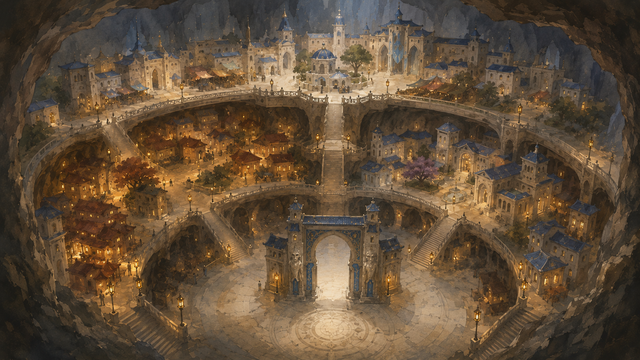
Esikkent is built in a roughly circular shape, descending in three main levels around a wide open centre. The upper levels are arranged like broad terraces, allowing people to look across the city and down toward the Gate Floor below. From many points in Esikkent, the Janus Gate remains visible at the heart of the city.

Though it sits underground, the city is not dark or cramped feeling. Its walls are carved from warm honey-coloured stone, pale limestone, and older dark rock left visible in places where the city cuts deepest into the earth. Some buildings are built directly into the rock, while others rise from the terrace floors in narrow, uneven rows.


The Upper District
The Upper District is the highest level of Esikkent and the main point of arrival for most visitors. Cabinet receiving rooms, and the entrance from the fountain all open into this level, making it the busiest and most accessible part of the city.

The Upper District is more open and orderly than the lower parts of Esikkent. Its streets are broad and well-lit, and are filled with inns, public bathhouses, luxury shopping, and restaurants.

Markets in the Upper District tend to cater to travellers rather than residents. They sell luggage charms, language aids, guidebooks, tea, sweets, maps, tacky knick-knacks and chachkis to tourists.


The Lantern District
The Lantern District takes up one half of Esikkent’s middle level, and is the city's residential area.

The district is built along the circular terrace overlooking the open centre of the city. Homes, family shops, courtyards, tea rooms, bakeries, grocers, bathhouses, and small neighbourhood markets line its streets. Many buildings are stacked closely together, with balconies, stairways, bridges, and narrow lanes connecting homes and businesses.

The district gets its name from the many lamps and lanterns hung outside doors, over bridges, along canal railings, and across courtyards. At night, the Lantern District glows gold, blue, and amber from hundreds of small lights.


The Civic District
The other half of Esikkent’s middle level is the Civic District, the city’s main centre for schools, offices, and professional work. Many of its buildings are made from pale stone and blue tile, with tall windows looking out toward the open centre of the city.

Many of Esikkent’s public institutions are found in the Civic District. These include local schools, healer rooms, translation houses, legal chambers, licensing counters, and administrative offices.


The Gate Floor
The Gate Floor sits at the bottom of Esikkent’s open centre. From the balconies and bridges above, visitors can look down and see the Janus Gate standing at its heart. The surrounding floor is broad and mostly open, designed to hold formal gatherings, public witnesses, diplomatic ceremonies, and events.

The Gate Floor is quieter than the districts above. Its walls carry old inscriptions, treaty marks, names of witnesses, and fragments of earlier agreements. Some are written in recognizable scripts. Others belong to older magical traditions, including those tied to the First Threshold Accord. The level is carefully maintained, but not polished clean of age.

During major events, the quiet lower level becomes one of the most crowded places in the city, with residents and visitors watching from the floor itself and from the terraces above.
[Lore] Esikkent, Turkey

Posted: 29 Jun 2026, 12:27
by The Quill
The Janus Gate
Image

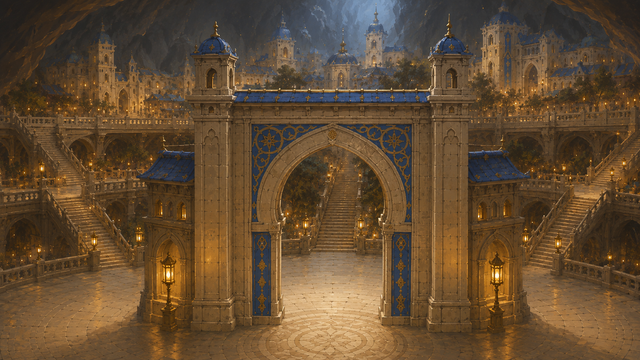
The Janus Gate stands at the centre of Esikkent’s lowest level, on the Gate Floor. It is the oldest and most important magical structure in the city, and the reason Esikkent became colloquially known as the Threshold City.

Appearance
The Janus Gate is made from dark stone, pale tile, and old bronze, with two great arches facing one another across a marked threshold line set into the floor.

The arches are broad and heavy, carved with old inscriptions, witness marks, and fragments of agreements made across generations. Some markings are written in recognizable scripts. Others belong to older magical traditions, including those tied to the White Ember Court and the First Threshold Accord.

The threshold line between the arches is narrow, bright, and carefully maintained. During ordinary days, the Gate is still and silent, though the space around it is never treated casually. The Gate does not glow, shimmer, or hang open. Most of the time, it looks like what it is: an ancient structure waiting for the correct moment, the correct witnesses, and the correct words.

The surrounding floor is open and ceremonial, designed to hold gatherings rather than daily traffic. During major events, people gather on the Gate Floor itself while others watch from the levels above. This makes the Janus Gate visible to the whole city, not hidden away in a private chamber or closed archive.


History
The Janus Gate was created during the later Roman Empire, after a conflict between Roman wizarding officials in Constantinople and the White Ember Court, a society of Veela in Heliopolis.

Roman wizarding officials wanted the White Ember Court brought into their treaty system, which required the court to accept a formal legal name and status within Roman magical law. However, to the White Ember Court, being named by an outside power was a sign of aggression.

A Roman interpreter and a Veela refrain-keeper recognized the danger before it became war. They understood that the problem was not simply poor translation, but the fact that each side expected its own form of law, record, and memory to carry more authority than the other’s.

The First Threshold Accord was created as a response. The Janus Gate became a neutral space for the two to gather and understand one another face-to-face.