City Layout
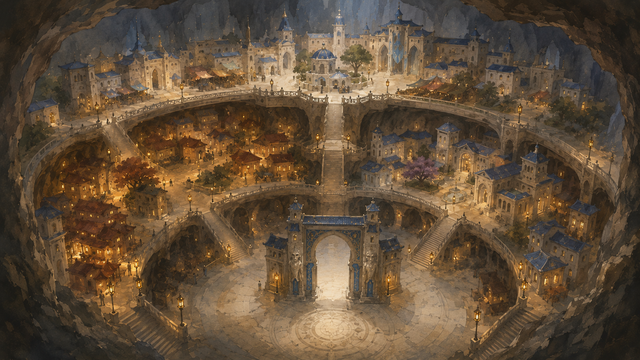
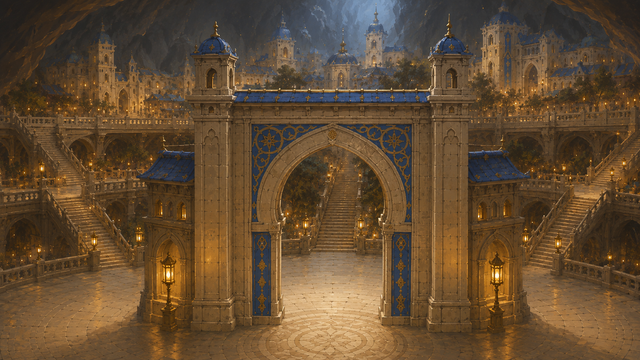
Esikkent is built in a roughly circular shape, descending in three main levels around a wide open centre. The upper levels are arranged like broad terraces, allowing people to look across the city and down toward the Gate Floor below. From many points in Esikkent, the Janus Gate remains visible at the heart of the city.
Though it sits underground, the city is not dark or cramped feeling. Its walls are carved from warm honey-coloured stone, pale limestone, and older dark rock left visible in places where the city cuts deepest into the earth. Some buildings are built directly into the rock, while others rise from the terrace floors in narrow, uneven rows.
The Upper District
The Upper District is the highest level of Esikkent and the main point of arrival for most visitors. Cabinet receiving rooms, and the entrance from the fountain all open into this level, making it the busiest and most accessible part of the city.
The Upper District is more open and orderly than the lower parts of Esikkent. Its streets are broad and well-lit, and are filled with inns, public bathhouses, luxury shopping, and restaurants.
Markets in the Upper District tend to cater to travellers rather than residents. They sell luggage charms, language aids, guidebooks, tea, sweets, maps, tacky knick-knacks and chachkis to tourists.
The Lantern District
The Lantern District takes up one half of Esikkent’s middle level, and is the city's residential area.
The district is built along the circular terrace overlooking the open centre of the city. Homes, family shops, courtyards, tea rooms, bakeries, grocers, bathhouses, and small neighbourhood markets line its streets. Many buildings are stacked closely together, with balconies, stairways, bridges, and narrow lanes connecting homes and businesses.
The district gets its name from the many lamps and lanterns hung outside doors, over bridges, along canal railings, and across courtyards. At night, the Lantern District glows gold, blue, and amber from hundreds of small lights.
The Civic District
The other half of Esikkent’s middle level is the Civic District, the city’s main centre for schools, offices, and professional work. Many of its buildings are made from pale stone and blue tile, with tall windows looking out toward the open centre of the city.
Many of Esikkent’s public institutions are found in the Civic District. These include local schools, healer rooms, translation houses, legal chambers, licensing counters, and administrative offices.
The Gate Floor
The Gate Floor sits at the bottom of Esikkent’s open centre. From the balconies and bridges above, visitors can look down and see the Janus Gate standing at its heart. The surrounding floor is broad and mostly open, designed to hold formal gatherings, public witnesses, diplomatic ceremonies, and events.
The Gate Floor is quieter than the districts above. Its walls carry old inscriptions, treaty marks, names of witnesses, and fragments of earlier agreements. Some are written in recognizable scripts. Others belong to older magical traditions, including those tied to the First Threshold Accord. The level is carefully maintained, but not polished clean of age.
During major events, the quiet lower level becomes one of the most crowded places in the city, with residents and visitors watching from the floor itself and from the terraces above.